New to Overkill? A Starter Guide to Four Decades of New Jersey Thrash

In 1980, in Old Bridge Township, New Jersey, a bassist and a drummer put out a call for bandmates. The bassist was D.D. Verni, the drummer was Rat Skates, and the singer who answered was Bobby Ellsworth, soon known to everyone as Blitz. More than four decades later, Verni and Blitz are still the core of Overkill, and the band has twenty studio albums behind it.
That is a lot of music to walk into cold. If a friend has just pressed an Overkill record into your hands, or you keep seeing that spiky green logo and want to know what it stands for, this guide gives you a clear way in: where the name comes from, which albums make good first stops, and which pieces line up with each one.
Where does the name Overkill come from?
The band took its name from Motörhead's 1979 album Overkill. Other names were on the table first, Virgin Killer among them, but Overkill stuck, and it fits. The band plays thrash metal: fast, heavy, loud and built for volume.
Two things help when you are new. First, the lineup has changed over the years (Rat Skates left in 1987, guitarist Bobby Gustafson in 1990), but Blitz on vocals and D.D. Verni on bass have been there since 1980. That continuity is a big part of why the band sounds like itself across so many records. Second, the band's look is just as steady: the acid-green logo, the bat skull with spread wings, and dark garments with green or white artwork. Once you know those, you will spot Overkill anywhere.
Where should you start listening?
You do not need to go in order. Think of the catalogue in a few stretches and pick the one that sounds most like you.
- The beginning (1983 to 1985). The demo Power in Black came in 1983, then the self-titled EP Overkill and the debut album Feel the Fire, both in 1985. Feel the Fire has "Rotten to the Core" and "Hammerhead" on it, and it is the natural first stop if you like your metal raw.
- The late-80s run (1987 to 1991). Taking Over (1987), Under the Influence (1988), The Years of Decay (1989) and Horrorscope (1991) came one after another. "Hello from the Gutter", "Elimination", "Coma" and "Infectious" all come from this stretch.
- The 90s (1993 to 1999). I Hear Black, W.F.O., The Killing Kind, From the Underground and Below and Necroshine, plus the covers album Coverkill in 1999.
- The 2000s and beyond. Bloodletting (2000) through Ironbound (2010), The Electric Age (2012), White Devil Armory (2014), The Grinding Wheel (2017), The Wings of War (2019) and Scorched (2023). Try "Ironbound", "Bring Me the Night" and "Electric Rattlesnake".
If you want the long version, the band's own walk through its albums from 1985 to 1999 goes record by record through the first stretch.
One more tip: Overkill has two live albums, Wrecking Your Neck (1995) and Wrecking Everything (2002). Live records are a quick way to hear a band's choice of songs from across the years in one sitting.
Which piece goes with the early records?
If Feel the Fire is your way in, the obvious match is the design named after it. The green Overkill logo sits above a row of figures standing in a wall of orange and amber flames, with the album title in orange lettering underneath. On black it looks like it is burning.
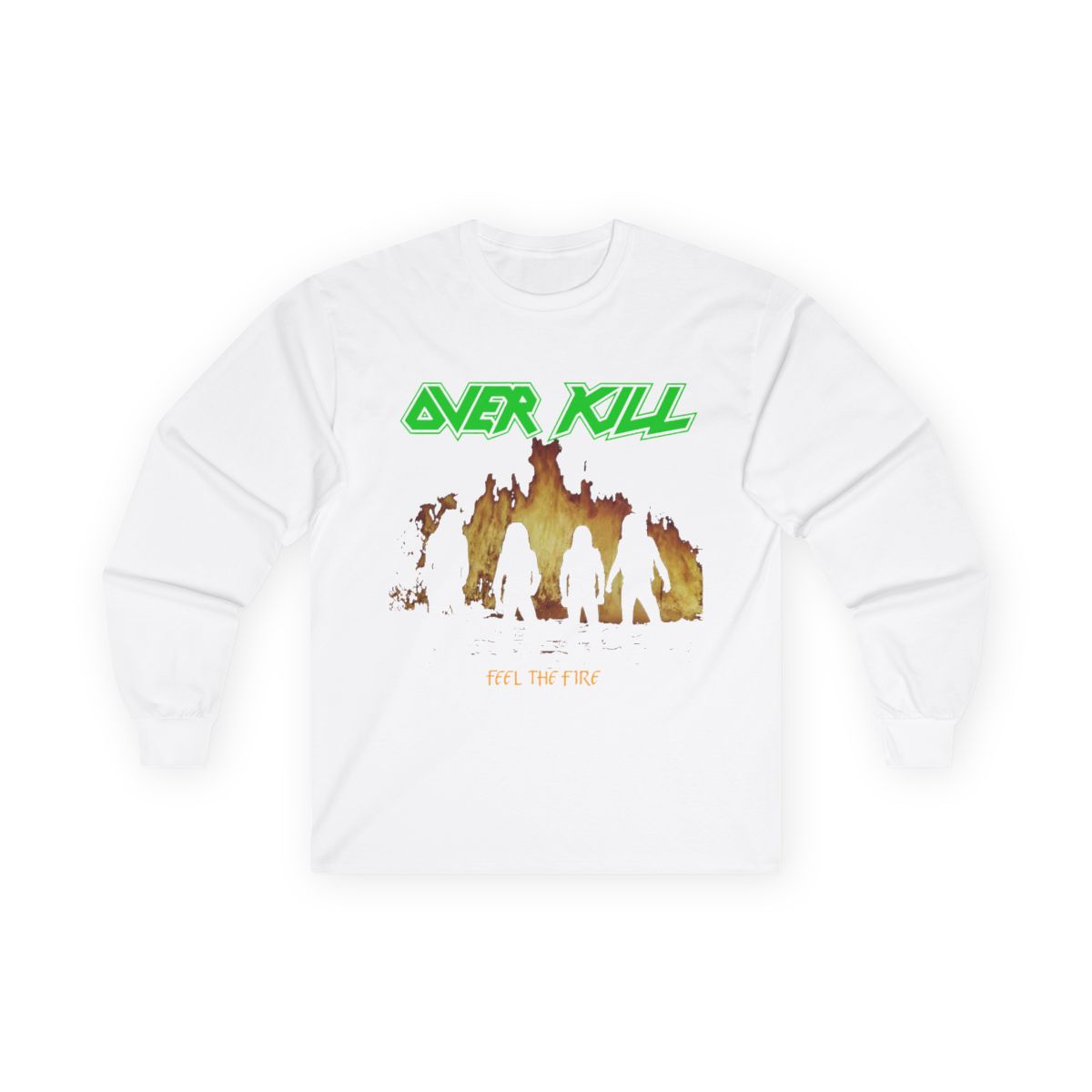
The Feel the Fire long sleeve tee is a good pick for colder months, when a short-sleeve band tee is not enough on its own. Wear it under an open flannel or a denim jacket and the flames still show.
For something plainer from the same family, the green logo on its own and the bat skull logo design carry the two marks people know the band by, with nothing else in the way.
And for the newer albums?
If you started at the other end of the catalogue, The Grinding Wheel (released 10 February 2017) is a strong pick, and it has its own design. On the front, a stone-textured Overkill logo sits over a bat-skull sigil and a gear, with orange sparks flying and the album title lettered in the wheel. On the back, Mean Green Killing Machine is spelled out in cracked green letters around a bat skull.
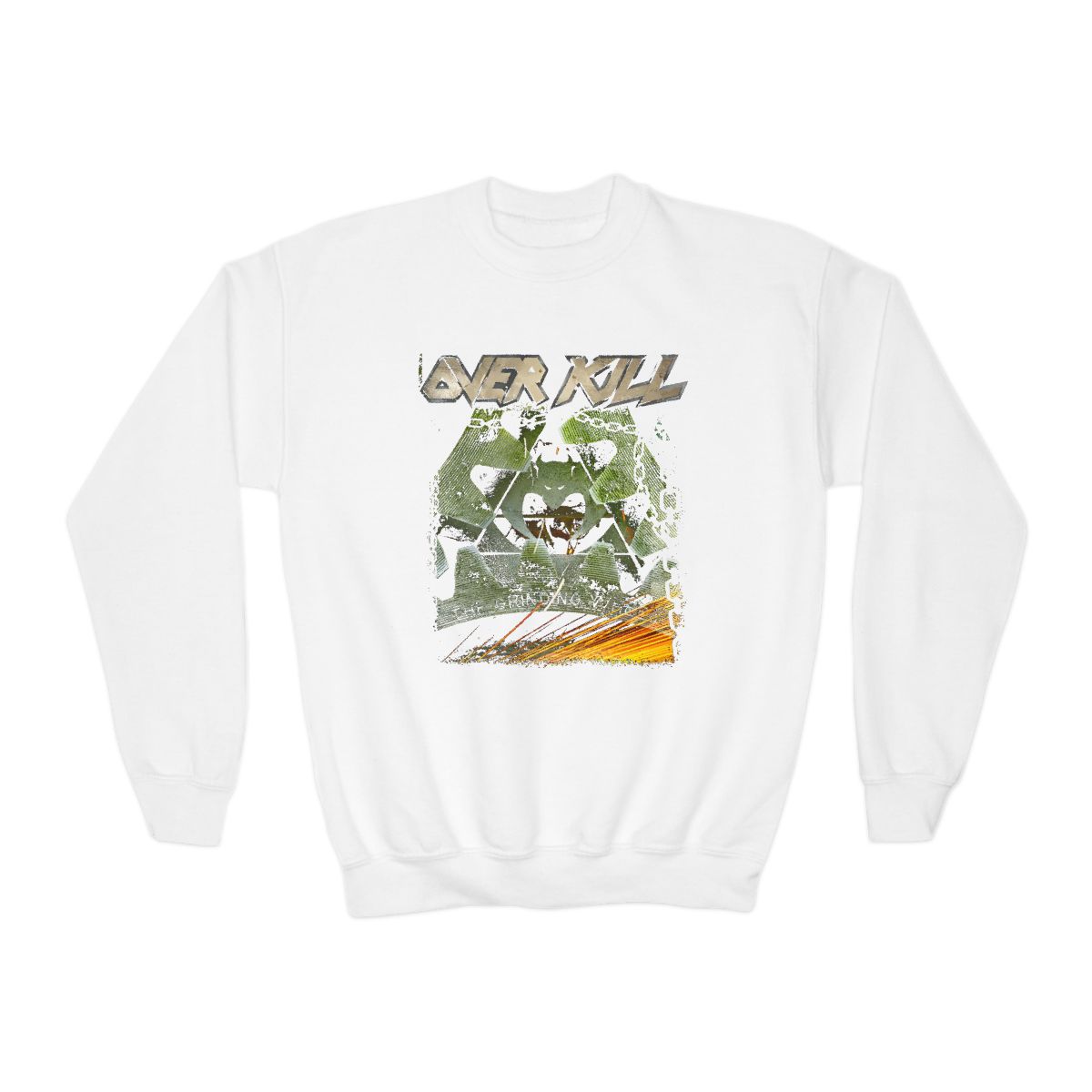
The Grinding Wheel and Mean Green Killing Machine youth crewneck puts that two-sided design on a sweatshirt sized for younger listeners, which makes it a thoughtful gift if the metal habit runs in your family. It is also one of the more striking designs in the range, because it uses both sides of the garment.
What if you just want something fun?
Not every Overkill design is about an album. Two worth knowing:
- Puck Hcky Worldwide. A single lime-green shape: the Overkill logo across the top, a spiked ring with a bat skull in the middle, and the words Puck Hcky Worldwide underneath. It mixes the thrash look with a hockey joke, and it reads clearly from a distance.
- We Don't Care What You Say. The green logo above a red raised middle finger wearing a ring. Blunt, and meant to be.
The Puck Hcky Worldwide long sleeve tee is the easy one to wear to a rink, a pub or a show, and it is a good conversation starter with anyone who gets the joke.
How do you pick your first piece?
A simple rule: start with the record you like, then choose the garment for when you will wear it.
- Pick your era. Feel the Fire for the early sound, The Grinding Wheel for the newer one, the logo or bat skull designs if you want the band's name with no album attached.
- Pick the season. Long sleeves and crewnecks for cold evenings, a tee for summer and for layering.
- Check the size. Every product page has its own size chart, for adult, youth and kids' garments.
Whichever album gets you hooked, there is a design that goes with it. Put the record on, find your piece, and turn it up.